More than $300 billion in stablecoins flows through DeFi every day. An increasing portion earns yield instead of doing nothing. Five years ago, holding stablecoins meant zero returns. Today, you have options - but they range from simple setups anyone can use to complex strategies that require experience. This guide covers that range.
Key Takeaways
- DeFi Lease Innovation: Nolus features a leasing-style algorithm that can finance up to 150% of an initial contribution.
- Lower Liquidation Risk: The protocol handles positions with deeper safety margins, so the system tolerates sharper price swings before stepping in.
- True Asset Ownership: Unlike futures or perpetuals, borrowers retain full ownership of the underlying assets.
- Fixed Interest Rates: Nolus removes the guesswork from leverage by fixing interest rates at the start, protecting borrowers from the unpredictable fee surges.
- Cross-Chain Interoperability: The protocol is wired into multiple ecosystems, so liquidity and swaps aren't limited to a single network.
What Are Stablecoins

Stablecoins are cryptocurrencies designed to maintain a $1 peg through different mechanisms: fiat reserves, crypto collateral, algorithmic supply adjustment, or derivatives strategies. Each model presents different risk and return profiles.
For years, stablecoins served a single purpose: they were trading rails and DeFi building blocks. You held them to avoid volatility, then immediately deployed them elsewhere. That changed as two structural shifts occurred simultaneously.
The stablecoin market matured. The ecosystem now supports $300+ billion across dozens of protocols and 50+ blockchains. This liquidity depth eliminated the boom-and-bust dynamics of earlier cycles, stabilizing borrowing rates and making yields predictable.
And yield-bearing stablecoins emerged as a distinct asset class. Unlike traditional stablecoins (USDC, USDT) that sit idle, tokens like sUSDe (Ethena) and sUSDS (Sky Protocol) automatically compound earnings. Holding them is passive: your balance grows every day without claiming rewards or rebalancing. This model appeals to institutions managing treasury reserves who previously dismissed crypto as speculative.
The Stablecoin Categories: Not All Created Equal
Before understanding where yields come from, you need to know what's actually backing the stablecoins you hold. The ecosystem has fragmented into different approaches: some use fiat reserves held by banks, others use crypto locked in smart contracts, some route yields from Treasury bonds, and a few rely on derivative strategies. Each trades off different things: simplicity for transparency, decentralization for stability, and capital efficiency for safety.
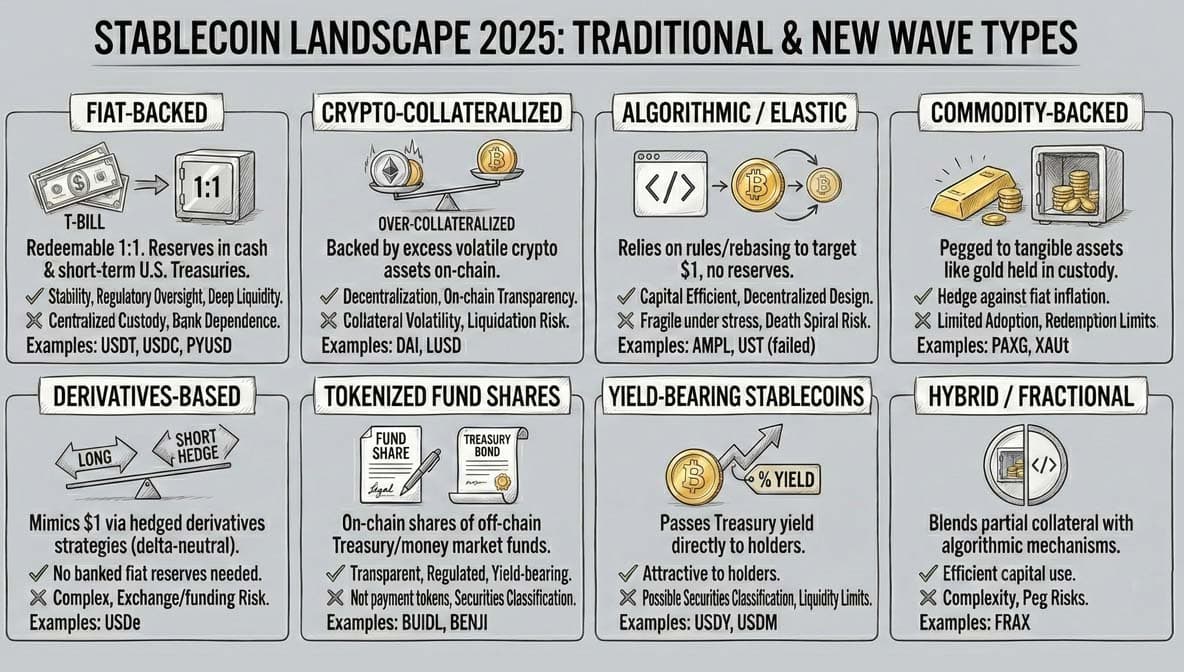
Our guide on stablecoin types breaks down how each mechanism works and why the choices matter. The history of stablecoins explains how we got from early experiments to today's ecosystem.
The key distinction for yield strategies: some stablecoins don't generate returns by themselves (you have to move them to earn yield), while others, like yield-bearing stablecoins, automate this process, passing income directly to holders - either through rebasing (increasing the token balance) or value-accrual mechanisms. That difference shapes everything about how you actually use them.
The Foundation: Understanding Why Stablecoin Yield Exists

Stablecoin yield isn't free money. It emerges from real economic activity: borrowers accessing capital. To understand the mechanics, you need to understand this fundamental relationship.
Stablecoins exist in different forms, and each type operates through different mechanics, but they share a common feature: they maintain a stable peg rather than speculate on price.
When you supply stablecoins to a lending protocol, you're doing something basic: you're giving someone the ability to use your capital. That someone, a trader opening a leveraged position, a protocol needing temporary liquidity, and an arbitrageur executing a complex strategy, pays for that access. The payment takes the form of interest.
For example, lending protocol mechanics: borrowers typically pay 3–5% APR to access stablecoins, while suppliers earn 2–4% APR depending on market conditions. The spread between these rates covers the protocol's reserves, with rates fluctuating hourly based on supply and demand. When traders borrow heavily, rates spike. When borrowing demand drops, rates compress.
This spread-based model exists across lending protocols because it reflects real market conditions. Rates act as a market signal. High rates attract new suppliers and discourage new borrowers. Low rates do the opposite. Over time, this adjusts supply and demand toward equilibrium.
Understanding this foundation matters because it explains why yield varies, why rates change unpredictably, and why higher yields come with higher risks. Excluding temporary marketing incentives, if a mechanism offers a 15% yield, someone is paying 15% to borrow, which typically means either very high market volatility or unstable collateral backing the loan.
Why Now? Three Structural Shifts in 2026
Stablecoin yield used to be a footnote in crypto conversations. It's not anymore. Three things changed:
First, the market stabilized. Borrowing rates stopped spiking wildly, they became predictable. Protocols stopped offering 20% incentives and settled into sustainable 3–10% yields.
Second, institutional capital arrived at scale through compliance-first infrastructure. Institutional participation in DeFi shifted from experimental to operational in 2025. Major financial institutions, including BlackRock, JPMorgan, DBS Bank, and Goldman Sachs, now use DeFi rails for portions of their treasury operations and settlement. By late 2026, institutional money could represent 30–40% of DeFi if regulatory clarity and institutional infrastructure continue maturing at the current pace.
Third, yield-bearing stablecoins moved to the mainstream. Instead of niche DeFi plays, they are now packaged as conservative, income-focused products used by both retail and professional investors across major ecosystems. These products route underlying collateral into lending, RWA strategies, or protocol revenue share, then pass returns back to holders via automated mechanisms.
The result: stablecoin yields broadly sit in the same 3–6% band as traditional money market funds, but with 24/7 liquidity, programmable access (vaults, tranches, automated strategies), and no reliance on relationship-based banking or manual approvals. In practice, that means on-chain cash management can now realistically compete with off-chain treasury products on yield, flexibility, and global accessibility, not just on ideology.
What Makes Stablecoins Ideal for Yield Strategies?
Here's why stablecoins work so well for earning income compared to other crypto assets.

They don't move. Bitcoin and Ethereum are volatile. Stablecoins stay at $1. That means when you earn a 5% yield, you actually know what you'll get. No surprises from the price crashing. You can actually plan around the numbers instead of hoping they work out.
Everyone can get in and out easily. Stablecoins trade on every exchange, in every pool. If you want to move money from one lending platform to another because rates changed, you can do it instantly without losing money to slippage. That matters for treasuries that need to move fast.
Borrowing stablecoins is common. Traders want stablecoins to open leveraged bets. Funds want them to hedge. That's why lenders consistently earn interest - there's real demand from people willing to pay. It's not magic, it's just supply and demand.
Stablecoins are tied to smart contracts. You can move them between lending platforms, set up automated strategies, and compose them into complex products. That flexibility is what makes the whole ecosystem work - you can earn yield on one platform, use those earnings elsewhere, all on-chain.
Low Volatility Pairing. Stablecoin liquidity pools have lower volatility risk than crypto-crypto pairs, so you mostly just earn trading fees. But they can de-peg in extreme conditions. ETH-USDC pools have much higher volatility risk where you can lose money from price swings.
That's it. Stablecoins are liquid, in-demand, and they work in code. That combination is why people can actually make money lending them out.
Mechanisms: How Income Gets Distributed
How does a stablecoin actually generate yield? The answer depends on the mechanism. Different protocols use different approaches, and understanding them is key to knowing what you're actually earning.

Spread-Based Lending
The oldest mechanism: you supply stablecoins to a lending protocol, borrowers pay interest, and you capture a portion of that interest. Major DeFi lending platforms operate on this model. The protocol matches lenders with borrowers and takes a fee.
The strength of this model is transparency. Rates are visible, auditable, and emerge from real supply/demand mechanics. You can see exactly how much is borrowed, at what rate, and how the spread breaks down.
The weakness is rate volatility. A position earning 4% one week might earn 2.5% the next week as borrowing demand changes. For treasuries managing reserves, this unpredictability creates forecasting challenges.
Governance-Backed Savings Mechanisms
Different protocols distribute a portion of their revenues directly to token holders through rebasing stablecoins. Governance holders vote to decide how much revenue to distribute. The token itself rebases daily (your balance grows automatically), eliminating the need to claim or redeposit.
The strength: it's genuinely passive. No claiming. No rebalancing. Your holdings increase daily without any action. This simplicity has attracted institutional deposits seeking predictable, hands-off income.
The weakness is governance risk. The savings rate is determined by voting, not by market mechanics. Voters could theoretically reduce the rate. The sustainability depends on ongoing protocol profitability and voter commitment to maintaining distributions.
Derivatives-Based Yield
Some stablecoins maintain their peg through derivative strategies rather than direct collateral. These protocols hold crypto assets, then short equivalent perpetual futures contracts to remain delta-neutral.
When traders pay funding rates to maintain long positions (common during bull markets), these protocols collect those fees and pass them to holders via daily rebasing. The yield varies based on market leverage conditions, but can fluctuate significantly.
The strength: this creates a self-adjusting system. When leverage is extreme, funding rates spike and yields increase. When markets stabilize, funding rates get lower, and yields decrease. There's no governance voting required.
The weakness is precisely that feature: yields depend entirely on market conditions. If traders unwind leverage or funding rates collapse, yields can approach zero quickly.
Staking on DeFi Protocols
Other protocols integrate stablecoin yield mechanisms directly into their design. These protocols automatically rotate deposited capital between multiple yield sources (DeFi lending, treasury strategies, or other instruments) without requiring user action. The protocol allocates capital to whichever source pays best at any given time.
Alternative staking models let users deposit stablecoins into pools, where they earn fees from trading activity.
The strength: seamless and integrated. You earn whatever the market's best yield is without researching where to deploy manually.
The weakness: reward rates depend entirely on protocol health and market activity. If borrowing demand collapses or liquidations dry up, yields can drop significantly. During downturns, these yields have fallen to 2–3% APY.
Centralized Finance (CeFi) Platforms
Centralized exchanges offer yield on stablecoins through lending desks or revenue-sharing models. Users deposit stablecoins and earn yield without managing DeFi protocols themselves. Rates typically range from 3–5% APY depending on the platform and conditions.
The strength: ease of use, good user experience, and integrated fiat onramps. No smart contract risk, no managing wallets or transactions.
The weakness: custodial risk and regulatory exposure. Your coins are held by the platform, not by you. If the platform faces regulatory action or insolvency, your funds are at risk.
Real-World Asset (RWA) Backed Yield
Some protocols supply stablecoin liquidity into off-chain instruments like Treasury bills, corporate bonds, or other regulated debt. These mechanisms connect on-chain capital with traditional finance yield sources.
RWA-backed yields typically range from 4–5% for Treasury-backed products, with institutional pools sometimes offering 8–16% for higher-risk corporate or structured debt.
The strength: stable, predictable yields similar to traditional finance. You're earning income from real economic activity (government debt, corporate loans) rather than speculation or leverage.
The weakness: it requires trust in intermediaries who hold the underlying assets. Withdrawal or redemption timelines may be slower than DeFi, some RWA pools lock capital for 30 days or longer. If underlying assets decline in value or borrowers default, your principal is at risk.
The Distribution: How Income Gets to Holders
Once yield is generated, it must reach token holders. Three distribution methods exist, each balancing ease, cost, and automation differently.
Claiming and Redepositing
Traditional lending protocols require users to periodically claim accrued interest and redeposit it to compound returns. This creates friction: transaction costs, timing risk, and operational overhead. For individuals managing $10,000 positions, claiming quarterly might make sense. For treasuries managing $100 million, it creates a significant operational burden.
Rebasing Tokens
Yield-bearing stablecoins automate this through rebasing. Your token balance increases automatically every day without any action. This eliminates operational friction. Treasuries don't need to monitor claiming schedules or manage rebalancing. The token itself does the work. This explains why rebasing stablecoins attract institutional interest - the simplicity alone justifies lower yields compared to self-managed strategies.
Tokenized Yield Separation
Some protocols separate yield from principal through tokenization. When you deposit a yield-bearing asset, the protocol splits the position into two components: one representing the principal (redeemable at a future maturity date) and another representing all the accumulated yield.
This creates markets where fixed yields become tradable. Principal tokens typically trade at a discount to the underlying asset because they don't include the yield component. That discount represents the fixed return you're locking in. If markets are pricing principal tokens to mature at a 6–7% fixed yield, that rate is locked in for you.
The strength is clarity - you know exactly what you're earning on your principal. You can plan around a guaranteed return. The weakness is complexity and liquidity. These markets are smaller and more specialized than primary lending markets. If you need to exit before maturity, you might face liquidity constraints or price slippage.
Additionally, yield tokens (representing the future yield component) become independently tradeable. This lets people speculate on whether yields will rise or fall without exposing their principal. But for most conservative users, the appeal is simply the fixed-rate certainty on the principal side.
Risk Layers: Understanding What Can Go Wrong
Every yield mechanism carries distinct risk layers. Understanding these layers matters more than chasing the highest yields.

Smart Contract Risk
Any protocol offering yield does so through code. Code can have bugs. Evaluating code risk means checking audit history, verifying insurance coverage, and assessing how long code has been battle-tested in production. Protocols that have been operating for years with billions in active capital have generally surfaced major vulnerabilities. Newer mechanisms carry more code risk simply because they've had less time to prove stability and reliability.
Counterparty Risk
Centralized platforms hold your capital. If the platform is hacked, if regulators freeze accounts, or if the company fails, your capital is at risk. This risk doesn't exist with self-custody on decentralized protocols. The tradeoff: centralized platforms offer better UX and easier onramps, but you're trusting an institution with your money.
Liquidation Risk
Leverage strategies create liquidation exposure. If you borrow capital at one rate and invest it at a higher rate, a spike in borrow rates can render the position unprofitable. More critically, if collateral moves against you (stablecoins depegging), liquidations can cascade quickly. The position that looked safe suddenly becomes insolvent.
Rate Risk
Spread-based lending rates fluctuate with supply and demand. A position earning 4% today might earn 2% next month. This volatility makes forecasting difficult and requires ongoing monitoring to identify changing conditions. It's unpredictable income.
Governance Risk
Governance-backed yield mechanisms depend on voter commitment. Voters could cut savings rates. Governance could change protocol direction entirely, deprioritizing yield distribution in favor of other priorities. If you're relying on a governance-determined yield, you're betting that voters continue to support it.
Peg Risk
Stablecoins maintain $1 pegs through different mechanisms. If that mechanism fails, collateral becomes insufficient, governance breaks down, or derivative strategies unwind, depegging can occur. Historical examples show stablecoins can de-peg in extreme conditions. Once confidence breaks, recovery can be slow.
Regulatory Risk
Stablecoins' legal status remains disputed in many jurisdictions. Interest income on stablecoins is likely taxable as ordinary income in most jurisdictions. Regulatory tightening could restrict yield mechanisms, freeze protocols, or classify stablecoins differently than current expectations. This risk isn't theoretical - it's actively shaping the ecosystem.
Getting Started: Evaluating Mechanisms

If you're considering stablecoin yield, evaluate mechanisms rather than individual offerings:
1. Understand the income source. Does yield come from borrowing demand (spread-based)? Governance distribution (voted)? Market conditions (derivatives)? Each source behaves differently.
2. Assess operational burden. Does the mechanism require claiming and rebalancing? Does it rebase automatically? How often do you need to monitor it? Match this to your time commitment.
3. Evaluate risks explicitly. Audit history, insurance coverage, code maturity, and team track record.
4. Test with small positions. New mechanisms often seem attractive until capital saturates them and rates go down. Testing with 10% of the intended position reveals this dynamic before full deployment.
5. Monitor continuously. Check rates weekly on lending protocols. Watch governance proposals for potential changes. Reassess if conditions shift meaningfully.
Understanding vs. Chasing
The stablecoin yield market offers real opportunities and real risks. The key difference between successful participants and those who lose money is understanding mechanics before deploying capital.
High yields attract capital. In turn, that capital decreases yields. It reveals which participants got the underlying rules (and stayed) and which simply chased rates (and left at losses). This cycle repeats across DeFi with predictable timing.
Start by understanding. Deploy capital after understanding. Adjust positions as conditions change. This approach generates sustainable income rather than chasing yields until they evaporate.
The information provided by DAIC, including but not limited to research, analysis, data, or other content, is offered solely for informational purposes and does not constitute investment advice, financial advice, trading advice, or any other type of advice. DAIC does not recommend the purchase, sale, or holding of any cryptocurrency or other investment.