he blockchain world is increasingly multichain, with thousands of projects launching across different ecosystems. Behind many Cosmos-based and application-specific blockchains sits a robust consensus engine: CometBFT. It is likely that if you've ever used any blockchain from the Cosmos universe, then already you've derived some benefit from CometBFT without even knowing it.
This article explains what CometBFT is, how its BFT consensus works, and why it matters for the Cosmos ecosystem and the broader multichain future. We’ll keep the mechanics simple.
Key Takeaways
- Built for the Multichain Universe: CometBFT is one of the core technologies behind the Cosmos "Internet of Blockchains."
- Beyond Tendermint: CometBFT is the fork and successor to Tendermint Core. It launched through a coordinated Interchain effort and is now maintained as part of the Cosmos Stack.
- Fast Finality, BFT Security, and Interoperability: That’s CometBFT in a nutshell. It underpins many application-specific chains across the Interchain.
- Developer-Friendly: ABCI makes it easy to build custom, application-specific blockchains.
What is Blockchain Consensus?
Before we dive into CometBFT, let's talk about consensus. Imagine a group of people trying to agree on a single, shared record of events – who paid whom, when, and how much. In the real world, we rely on third parties like banks to hold these records. But in the decentralized world of blockchain, there is no such central entity. So, how do all the computers, or nodes, in a blockchain network agree on the correct order of transactions?
That's where consensus algorithms enter the scene. They are the protocols by which all the nodes agree that they all see the same, identical view of the blockchain's history. Without consensus, the blockchain falls apart – you'd have incompatible versions of reality, and double-spending would be rampant.
Consensus can be achieved in different ways. You probably know Proof-of-Work (PoW), which is used by Bitcoin, where miners compete to solve puzzles. Another widespread method is Proof-of-Stake (PoS), where validators "stake" their cryptocurrency in order to participate in the network.
A Brief History: From Academic Roots to CometBFT
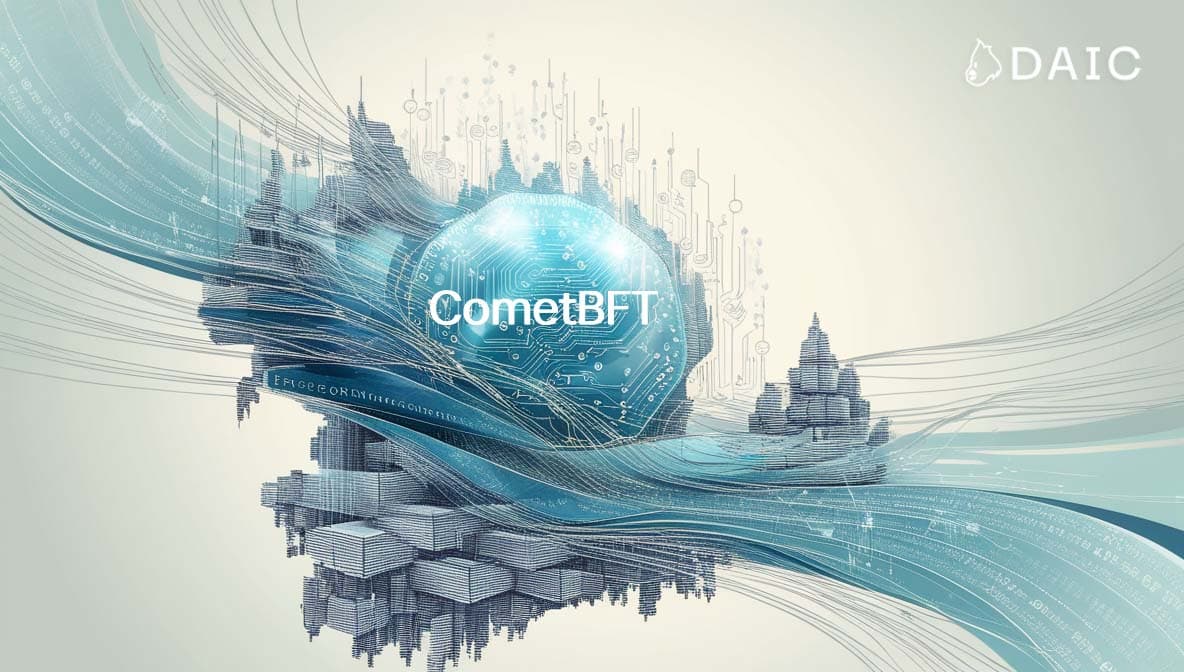
CometBFT's history begins with Byzantine Fault Tolerance (BFT), a classic distributed-systems problem from the 1980s. Imagine generals coordinating a castle siege, some secretly misleading - "Attack!" here, "Retreat!" there. BFT ensures honest ones agree, even if there are traitors. Blockchain nodes are those generals, agreeing on some blockchain processes. The key assumption: less than one-third of voting power can be Byzantine. If that threshold is exceeded, the safety assumptions no longer hold.
There is no single BFT solution - there are many approaches fueling today's consensus algorithms. In 2014, Jae Kwon saw BFT’s potential to outshine Bitcoin’s power-hungry PoW. His creation, Tendermint, blended academic BFT with blockchain, using validators who stake crypto, risking “slashing” if they misbehave. Slashing was the hot topic among PoS enthusiasts (think Vitalik Buterin’s ideas), but Kwon made it real in Tendermint, making it a PoS pioneer.
In 2023, the Tendermint Core project forked into CometBFT. The new project was launched as a coordinated effort across the Interchain Foundation, Informal Systems, the Cosmos SDK team, and many other Cosmos ecosystem teams. Today, CometBFT is maintained as a core Cosmos Stack component, with Cosmos Labs listed as maintainer and open-source contributors supporting the wider stack. The launch of CometBFT was a large collaborative project, with the Interchain Foundation, Informal Systems, the Cosmos SDK team, and numerous other Cosmos ecosystem teams. That collective effort speaks to the importance of CometBFT as a fundamental technology for the "Internet of Blockchains." The participating teams designed the transition to be as smooth as possible for developers and validators already relying on Tendermint Core.
CometBFT: The Engine, Explained
CometBFT is an open-source, Byzantine Fault Tolerant state machine replication engine and blockchain application platform. That's a mouthful, but basically, CometBFT is software that allows a network of computers to agree on the same set of data, even if some computers fail or are malicious.
CometBFT is usually easiest to understand through two core pieces:
The Consensus Engine: This is the essence of CometBFT, the underlying set of rules that determines how nodes propose, vote on, and finalize new blocks of transactions. This engine is similar to the strict rulebook that forces all honest nodes to do the same thing and reach the same conclusion.
The Application Blockchain Interface (ABCI): This is the interface between CometBFT’s replication engine and the application state machine. It lets the consensus layer handle networking, ordering, and finality while the application defines its own logic. But just what is "application"? The application, under the CometBFT framework, is the logic program of an application-specific blockchain. Instead of writing a dApp on a mainstream blockchain, developers use CometBFT and ABCI to build an entire blockchain customized for their specific application. In a key differentiation, application logic can be written in the programming language and environment best suited to the project, as long as the application remains deterministic.
CometBFT has continued to evolve. ABCI 2.0, introduced with CometBFT v0.38, expands what applications can do at consensus time, including features such as vote extensions. Of course, for anything to work, nodes need to be able to communicate with one another. CometBFT has robust networking capabilities to enable correct message passing and participation in the consensus protocol.
How CometBFT Works (Simplified)
Picture a set of validators, each with voting power usually tied to stake in a Proof-of-Stake network. Their role? Agreeing on the next batch of transactions (a block) to keep the chain growing. Here’s how they do it, step-by-step:
- Propose: One validator, picked based on their stake, steps up and says, “Here’s my proposal for the next block!”
- Prevote: The other validators prevote on the proposed block. This is like saying, "I think this block looks valid."
- Precommit: If more than two-thirds of the validators (weighted by their voting power) prevote for the block, they then precommit to it. This is a stronger signal of agreement.
- Commit: Once more than two-thirds of voting power precommits to the same block in the same round, the block is committed and final under CometBFT’s safety assumptions.
On the illustration below, you will see validators in a polka dance, symbolizing their consensus process. A “polka” occurs when over two-thirds, by voting power, prevote for the same block. Precommits require this polka from the same round, and a block is committed with over two-thirds precommitting.
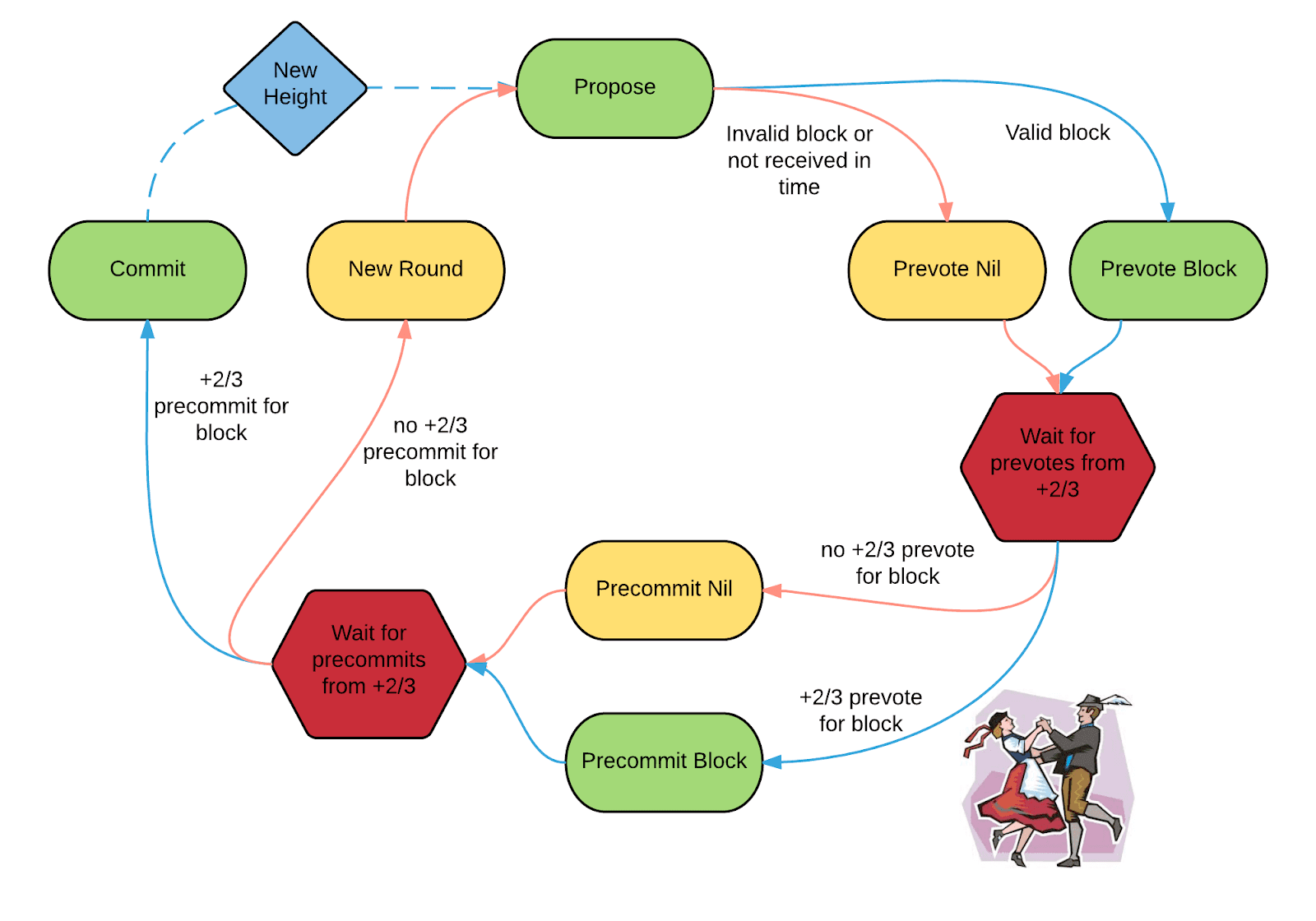
This whole process can finalize blocks quickly, often in seconds depending on the chain’s configuration and network conditions. Thanks to Byzantine Fault Tolerance (BFT), it works like a charm even if some go offline or turn rogue, the network stays rock-solid, keeping your transactions safe and sound.
Why CometBFT Matters: The Benefits
CometBFT powers blockchains with a standout set of advantages - here’s why it’s a game-changer:
Security: Its Byzantine Fault Tolerant design is built to preserve safety as long as less than one-third of voting power is Byzantine.
Performance: CometBFT is designed for efficient block propagation, consensus, and finality. Recent releases have continued to focus on performance and networking improvements, including v0.39’s libp2p-based networking option, Adaptive Sync, and multiple consensus, state, and P2P optimizations.
Interoperability (The Cosmos Vision): CometBFT is a core part of the Interchain Stack, often used alongside the Cosmos SDK and IBC. ABCI gives developers a clean boundary between consensus and application logic, while IBC handles cross-chain communication.
Fast Finality: CometBFT provides deterministic finality once a block is committed by more than two-thirds of voting power. In practice, many CometBFT-based chains finalize in seconds, instead of relying on long confirmation windows.
Developer Freedom: ABCI lets developers focus on application logic while CometBFT handles replication, networking, and consensus. Applications can be written in different languages, as long as their state transitions are deterministic.
CometBFT expands on Tendermint's work and optimizes it for today's requirements, delivering security, speed, and flexibility that make it a mainstay of contemporary blockchain ecosystems.
CometBFT Today and Tomorrow
CometBFT’s clearest use case is in the Cosmos and Interchain ecosystem, where many application-specific chains use CometBFT with the Cosmos SDK and IBC.
CometBFT continues to develop. ABCI 2.0 is already part of the supported v0.38 line, and the current v0.39 release line adds further performance, networking, and sync improvements. Longer term, CometBFT remains positioned as a core consensus and replication engine for application-specific blockchains. Its proven reliability and interoperability edge see it as a technology to watch, even if challenges like how to ensure a diverse validator set remain crucial for any decentralized solution. Even so, CometBFT's robust design ensures it is a powerful consensus engine for blockchain's interoperable future. Explore the Cosmos ecosystem to see CometBFT in action across application-specific chains, validators, and IBC-connected networks.
The information provided by DAIC, including but not limited to research, analysis, data, or other content, is offered solely for informational purposes and does not constitute investment advice, financial advice, trading advice, or any other type of advice. DAIC does not recommend the purchase, sale, or holding of any cryptocurrency or other investment.